
"Oh, I don't invest in stocks. They're too risky" said a young (urban) professional friend of mine. Five minutes later he was reconsidering that statement, and you'll be happy to know he's now the proud owner of some stock (well, at least some stock mutual funds). That's right - today we'll talk about investment risk.
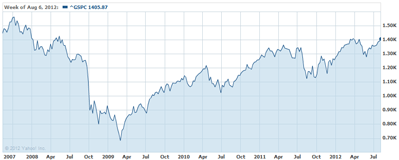
It's been a crazy 5 years in the S&P 500. (Yahoo!)
What exactly happened to my friend?
Simple - a personal finance rule of thumb, in this case "stocks are risky, bonds are safe", had somehow convinced my young friend that bonds were the place to park his not inconsiderable savings. Of course, what that statement leaves out is something obvious - with stocks, the investment risk you are concerned about with is returns.
And bonds, the so called safe option? Call it currency risk, and the risk of not having enough purchasing power when you want to retire.
Information Wants to Be Free!!!
I'll bet 95% of you have heard the phrase "information wants to be free", spoken by Stewart Brand about the dropping price of disseminating information. Maybe 2% of you know that it's part of a larger quote which also speaks to the value of information - that information wants to be cheaper and more expensive simultaneously (think music in the late 1990s/early 2000s).
Phrases such as Mr. Brand's tend to travel around in their most efficient means - leaving other pieces instead. To wit? "Look on my works, ye Mighty, and despair!" was about a king who was wiped out by history. Another? "To be or not to be" the beginning of Shakespeare's most famous soliloquy in Hamlet (and overall). It's a speech about suicide.
My point? Rules of thumb often leave out very important nuances which needs to be considered. In this case, inflation risk is what is left unsaid about bonds - and it is extremely important: you eventually need that money because you need to spend it.
Investment Risk: Back to Bonds?
So, stocks over the last 200 years or so average a return of 10.56% with a standard deviation of 18.82%. Seems scary, huh? 67% of the time you're bounded by a huge range of -8.26% and 29.38% (I know a normal distribution is inappropriate, but deal with it). Well, consider the alternative... buying fixed income assets today, or 'safe bonds? You'll book yourself a negative real return.
So - you tell me, young folks. Is it more of a risk to have huge swings in the portfolio value of your stocks, especially if you're under 30... or to essentially guarantee your savings grow slower than inflation. You got it - take a deep breath and invest in some so-called 'riskier' assets. You're welcome.
And if you ever want to see how the stock market performed in the past, take a look at our S&P Performance Calculator.
Have your younger friends ever told you stocks (or real estate) are too risky? Did you talk about currency risk? How do you view risk in your portfolio?
