
Editor: This article was first published in 2012. The conclusions are still good but note the age of the numbers.
When you woke up today you probably asked yourself this question – “is it better to go to college or to become a truck driver?“.
Inspired by a Twitter conversation from our friends JT at MoneyMamba and Matt Allen at Rambling Fever, we had to ask… how much do recently minted college graduates make when compared to their truck driving contemporaries?
Also read the follow up on Matt's site - Driving a Truck or Financing a Degree?
Should you get a Bachelor’s degree or drive a truck?
Most of you know what a Bachelor’s Degree is but few of you probably know the qualifications behind driving a truck. Here’s Matt's summary of qualifying to drive a truck:
I actually started out by going to college, chasing after that ever important degree, just like everybody else. My problem was, I had no idea what I wanted to be when I grew up. The college I attended was a mere five hour drive from my home. My many road trips to and from college is where I learned that I absolutely loved being on the road.
Fast forward a few years, leaving out some of my life details, and I finally get my commercial drivers license (CDL) at age 22. A CDL can be obtained at age 18, but you have to be 21 in order to drive across state lines. Before being issued a CDL, one must pass a written test, a thorough truck inspection test, and a driving test. Truck driver training courses are available everywhere and last as little as three weeks or as long as an entire college semester. The course I took, through a local community college, was five weeks long and added 14 credits to my college transcript!
At age 22, I could have taken a job with just about any over-the-road trucking company, but I was more interested in having a life and chasing after women. It took me three years before I was finally able to get a ‘good’ local trucking job. I continued to work on a shipping dock at a factory during the day while I picked up part-time trucking gigs on nights and some weekends. This part-time work was necessary because most of the companies that hire local (home every night) drivers, and pay well, require at least 2 years prior (truck) driving experience.
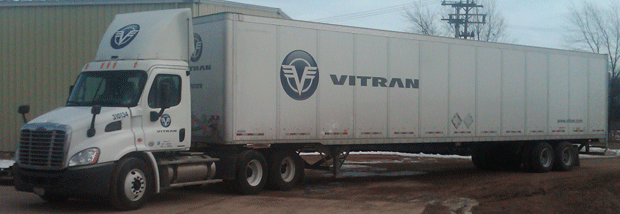
I am now in my tenth year working for the same company, driving the truck pictured above. I earn a higher than average income for my profession, as you will see in the following data. I get to come home to my family each and every night, just like the guy who sits in his office cubicle every Monday through Friday. Comparing a trucker to a degree holding white collar professional might seem apples to oranges, but I believe a fair comparison can be made.
Truck Driver Income vs. Graduate Income in 2010
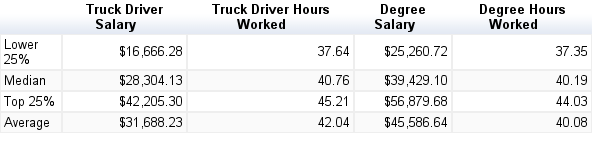
We ran the data for 24-30 year old truck drivers and degree holders.
'Degree salary' is for current graduates or otherwise listed in the ‘Methodology’ (below).
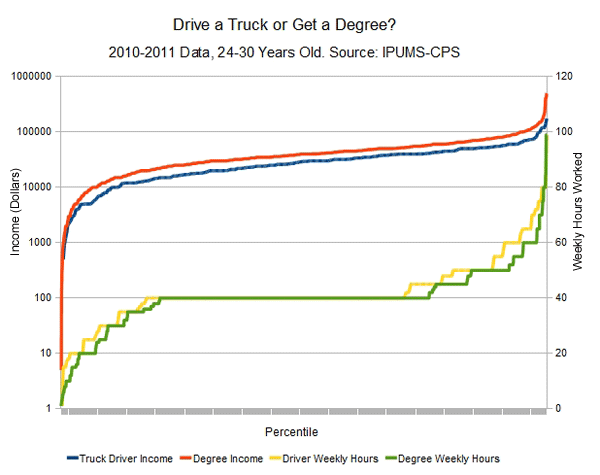
Here's the graph of 24-30 year old truck drivers versus degree holders for both hours worked and income. Income is a logarithmic scale (left) while hours are linear (right axis).
Methodology on Our Truck Driving Article
We get our data from IPUMS-CPS. Uee the variables ‘income’ and ‘usual hours reported worked per week’ for 24-30 year olds and tossed out the outliers. This data set only includes people who reported working 1 or more hours.
For 'truckers', I included the category “Driver/sales workers and truck drivers”.
Next remove people who are still in school. (We're only interested in current graduates.) This benefits the 24-30 year olds with degrees since theoretically truckers can start earlier (18 or 21, as Matt mentioned above).
24-30 years old also means we are talking about people in the beginnings of their respective careers. This matches the prompt's "just beginning a career".
Curve Fitting Truck Driver and Degree Income
We did our curve fitting at ZunZun. I used ZunZun's formulas to determine the median/top quartile/bottom quartile for each segment in the population.
As JT pointed out, even though Bus Drivers and Industrial Machinery Operators have similar qualifications, bus drivers do bring down the earnings of "Truck Drivers" when they are included. Matt adds, "[b]us drivers and industrial operators are entirely different breeds". I left them out in this post, but IPUMS-CPS has other categories if you are interested.
(Note that the code for ambulance drivers is '911'. Nice.)
Sources
Miriam King, Steven Ruggles, J. Trent Alexander, Sarah Flood, Katie Genadek, Matthew B. Schroeder, Brandon Trampe, and Rebecca Vick. Integrated Public Use Microdata Series, Current Population Survey: Version 3.0. [Machine-readable database]. Minneapolis: University of Minnesota, 2010.
Comparing Degree Holders and Truck Drivers is Comparing Apples and Oranges
For all of the problems with comparing young degree holders and young truck drivers, we can say a couple things with certainty:
- If a degree holder and a truck driver work the same number of hours, the degree holder will make more money on average
- Truck driving depends heavily on hours worked. Working hours determines miles driven which usually determines pay
Remember though: the barriers to entry in a “Degree Mandatory” job (namely, 4 years in school at a high price!) are different from a truck driving job. Additionally, people motivated to work many more hours might be better off driving than working overtime on a salary job. In most cases, overtime at an exempt salaried job only leads to indirect benefits like future promotions and not immediate pay increases.
Another important point is median individual income in the United States was $26,197 in 2010. 54.46% of 24-30 year old truck drivers earned more than median. 73.45% of all degree holders (in that age range).
Matt's Commentary on Truckers vs. Degree Holders
Here’s Matt’s interpretation of the data:
Well, numbers don’t lie, do they? I guess my expert interpretation of this data is: if you want to work less hours and make more money, get a degree. That is exactly what I plan to tell my kids when they get older, by the way.
The hours variable to this case study is huge. Sure, I make a higher than average income as a trucker, but I rarely work less than 50 hours per week. Yes, I am rewarded immediately for my long hours via overtime pay. Salaried workers only have a wish or hope of being rewarded for extra hours by future pay increases or a promotion. Consider the ‘over-the-road’ trucker though. Most of these drivers are paid only for the miles they drive. When they are halfway across the country, waiting to get loaded or unloaded, sleeping at a rest area, or showering in a truck stop, they are not being paid. This could be where the apples to oranges part of this comparison comes in.
Judging by my experience, the age factor plays a big role in these numbers too. When I started my ‘good’ job at my current company, I was 26 years old, and by far the youngest of all the drivers. It typically takes 2 to 6 years to reach top pay at a job like this, depending on the company. My point is, you usually don’t see truck drivers in the 24 - 30 age range who have yet reached their full earning potential. Drivers in that age range are typically working their ‘starter’ jobs to gain that invaluable experience.
One more thing to consider... when you change jobs, comparatively speaking, circumstances are way different. Generally, when a white-collar degree holder changes jobs, they get to negotiate their new salary (usually higher) and benefits. When a blue-collar worker (like a trucker) changes jobs, they get to start on the bottom and hope that benefits will kick in after 3 months. Due to average time on the job for all workers, and a high turnover rate in trucking, this factor could have a major affect on the averages used in this data.
In conclusion, I agree that time-wise and money-wise, having a degree is more beneficial. But, most of these degree jobs take place inside office buildings, perhaps with cubicles and people looking over your shoulder. I’ll take my 18-wheel office over that any day. After all, in what other office can I let one rip whenever I want, listen to the radio all day long and even sing at the top of my lungs if I want to. I know this has nothing to do with the data, but sometimes you have to just throw the data out the window. In the end, it’s all about personal preference.
So, readers, what do you think? Should you drive a truck or go to college?
