
• About / Contact
  • Calculators and Visualizations
  • Economic Concepts
  • Advertise
  • Disclosure

DQYDJ.net

Don't Quit Your Day Job: The Intersection of Personal Finance, Economics, and Politics.

RSS
  • Personal Finance
    • Debt
    • Retirement
    • Taxes
    • Health
  • Economics
    • Calculators
  • Politics
  • Investing
  • Offbeat
    • Weekender
    • Books
    • Music
    • Sports
  • Real Estate
    • Bay Area
  • Technology

Substitution vs. Income Effect (and its Implications)

Posted By CameronDaniels    Last updated February 20th, 2013 7 Comments

Refreshing on Economics terms? Click here for more Economics discussion.

Substitution and Income Effect:

These two terms are very familiar to anybody who has taken an intermediate course in macroeconomics.  With the recent articles (here, here, here, here, here and here) regarding volunteerism and labor statistics, I thought that it was very timely to write on these two very important concepts.

Let’s start with a thought experiment: if you were to receive a 10% increase in your hourly wage, would you increase, decrease, or maintain your hours worked?  Believe it or not, any answer is correct, despite many assumptions regarding the positive slope of labor supply curves.  The reason that any answer is correct lies in an understanding of substitution and income effects.

The substitution effect is the change in consumption patterns due to a change in the relative prices of goods.  For example, if private universities increase their tuition by 10% and public universities increase their tuition by only 2%, then it is very likely that we would see a shift in attendance from private to public universities (at least amongst students accepted to both).  The same can be said across brands, goods, and even categories of goods.  Examples would be the relative price of Pepsi vs. Coke, Red Meat vs. Poultry and Clothes vs. Entertainment.
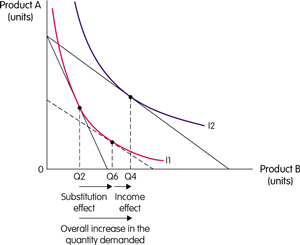
Substitution vs. Income Effect

The change of relative prices is the substitution effect (steep line to dotted line) and the change of purchasing power is the income effect (dotted line to parallel solid line)

The income effect is the change in consumption patterns due to the change in purchasing power.  This can occur from income increases, price changes, or even currency fluctuations.  Since income is not a good in and of itself (it can only be exchanged for goods and services, a point which has been debated recently by neuroeconomists), price decreases increase one’s purchasing power.  For example, a decrease in the price of all cars allows you to buy either a cheaper car or a better car for the same price, thus increasing your utility.  Goods typically fall into one of two categories: normal and inferior.  These categorizations relate consumption of a good with a particular individual’s income.  Normal goods increase in consumption as income increase while inferior goods decrease as income increases.  Also, some goods can be normal or inferior only on certain ranges of an income spectrum.  For example, education is a normal good: as one’s income increases (family income), demand for education increases.  As one’s income increases, hot dog consumption, however, typically decreases.

Now, let’s return to the main topic.  When dealing with labor supply, let’s look at one particular good: leisure.  Leisure is defined here as every hour not at your paid job, even if it is spent with your mother-in-law.  Leisure has been generally assumed to be a normal good.  Richer people retire younger and vacation time increases as one’s income increases.

Now, let’s look at what happens when your income increases.  Two very important things happen that contradict each other:

a.) Your demand for leisure increases (income effect, since it is a normal good), suggesting you will work less.

b.) The price of leisure, however, increases (the wage lost that you would have earned for that hour off has just gone up), suggesting you will work more (substitution effect).

There is no universal standard to determine which is more prevalent, it all depends on personal preferences.  For example, if you are working part time at 10 hours/week at minimum wage, it is very likely the substitution effect will dominate if you are bumped up to $10/hour.  Contrarily, if you are at the end of your career and receive a promotion, you very well may pare back your hours worked meaning the income effect will dominate.

What does this mean for charitable contributions?  In a recent article, my colleague Paul wrote that 45-54 year olds contributed the most, even during their highest earning years.  Without knowing more about the demographics of those volunteering, it is difficult to say more.  It could be explained, however, that the demand for charity (which is included in my definition of leisure) simply outweighs their cost of not working, which would easily explain why this seeming paradox exists.

There are many studies out there that have demonstrated that the price elasticity of labor supply is positive, meaning that the substitution effect dominates more than the income effect on the aggregate.  This is essential to a fundamental knowledge of economics in regards to the labor market as we understand it today.

Cheers,

Cameron Daniels


If you enjoyed this post, let others know!


Filed Under: Economics, Featured Tagged With: charity, Economics, goods, Income, labor, labor supply, leisure, substitution

DQYDJ Email Newsletter

Like what you see on this post?

Get the new stuff before everyone else. Sign-up below.


Follow @twitterapi


  • Pingback: Carnivals and Links, Week of May 3 – Don’t Quit Your Day Job

  • kartimone

    thank you. great refresher for my econ exam…i keep forgetting these!

  • Maani

    nice explanation

  • http://raymondcobham.wordpress.com/ Calvin Contreras

    Changes in price can affect buyers’ purchasing decisions; this
    effect is called the income effect. Increases in price, while they
    don’t affect the amount of your paycheck, make you feel poorer than you
    were before, and so you buy less. Decreases in price make you feel
    richer, and so you may feel like buying more.

  • ryan

    Thank you, much appreciated!

  • guest

     ” Leisure is defined here as every hour not at your paid job, even if it is spent with your mother-in-law.”  Lol, thats to funny. Thanx for this refreshment btw!

  • Pingback: “Why I believe in progressive taxation” | TheIndependent.ca

RSS Twitter Facebook Email

Connect

Subscribe to DQYDJ's RSS or Email feed:

Newest on DQYDJ

  • The DQYDJ Weekender, 5/18/2013
  • The Saturday Powerball Drawing: You Do Not Have a Positive Expected Value!
  • Predicting S&P 500 Closing Prices – May, 2013
  • Why Everyone Should Care About the IRS Targeting Conservative Groups
  • We’re ALL Financial Professionals

DQYDJ’s Greatest Hits

  • Would You Lie to Your Partner About Money?
  • Should Engineers and Business Majors Pay Higher Tuition?
  • How Did Mitt Romney Get a $20.7 Million IRA?
  • Dollar Cost vs. Lump Sum Investing: Where Dollar Cost Averaging Fails.
  • Racial Bias in Foul Rates among NBA Referees
  • Substitution vs. Income Effect (and its Implications)
  • When Stupid Ideas Go Mainstream: Algebra on the Chopping Block
  • Occupy Wall Street: How Much Do Republicans and Democrats Invest in Wall Street Firms?
  • S&P 500 Return Calculator
  • Ranking the Fed Chairmen: Why Paul Volcker Was The Best (And Bernanke Isn’t Bad…)

Sponsors


Advertise on DQYDJOnline - Save 15% on H&R Block At Home ProductsTurboTax is Easy, Free Edition, Fast RefundInvest Some Savings in a Peer to Peer MarketplaceProud Member of Yakezie

Links

  • 101 Centavos
  • Timeless Finance
  • Political Calculations
  • Hope to Prosper
  • Burbed
  • Financial Uproar
  • Money Mamba
  • The Free Financial Advisor
  • I Am One Percent
  • Modest Money

Return to top of page

Copyright © 2013 Don't Quit Your Day Job...

Some links on this page are tied to affiliate programs. See our disclosure page for more information.