
I apologize in advance: this post is going to be a bit heavy on theory and math.  We try to digest our statistics are much as possible here at DQYDJ, but this topic requires a bit more explanation than the average article on this site.

You see, a combination of Federal Reserve Policy and United States taxation law is literally eroding the value of your short terms funds.  Thanks to Robert Higgs at The Independent Institute for prompting this article on the expropriation of private wealth by the government.   Feel free to skip the two introduction sections below and get right to my point, or check out this WSJ article of a less wonky slant.

What is a Real Rate of Return?

To understand the real rate of return you need to understand the difference between the return of an investment and a change in price.  The concept of inflation (and deflation) mean that in the future, it will likely take more or less of a currency to acquire some good or service.  For example, a T-Shirt with a hilarious slogan might cost $15 this year, but $16.50 next year.  The price of the shirt actually ‘inflated’ 10%.  If you had invested $15 the previous year at a 5% interest rate, you made 75 cents.  Your real rate of return, if you only buy T-Shirts, was -5% – the difference between your return and the basket of goods you purchase.

The concept is exactly the same.  You can take a broad measure (like the Consumer Price Index) which calculates the change in price of a huge number of goods and compare it to your investment or savings returns to calculate your own rate of return.  So if you earn 10% on your stock investments and the CPI only increases by 3%?  Your real rate of return was 7%.

How Do Banks Determine Savings Rates?

Allow me to vastly simplify the banking system.  You know how we’ve written about using credit cards for liquidity?  Banks do the opposite of the strategy in that linked article.  You see, at it’s most basic, a bank reduces liquidity and pockets the difference in price between two levels of liquidity (short and long term).

The quote “borrow at 3%, lend at 6%” is apocryphal, but break it down when it comes to banks.  Banks ‘borrow’ money by issuing certificates of deposit and allowing people to open savings accounts.  This increases their deposits.  In theory, banking customers won’t need to access all of that money at once… so the bank can lend out money at much higher maturities (this is known as fractional reserve banking, and you better hope it works because our economy depends on it).  So a bank might have savings accounts paying 1%, and various loan products like car loans and mortgages which charge a higher interest.

One of the rates which savings accounts closely track is the Federal Reserve Primary Rate (Not the prime rate).  Large, healthy banks can borrow from the Federal Reserve at that rate – so it sets a sort of a lower bound (I know, I’m simplifying things) for the savings account rates banks will pay.  Why pay 5% when the Federal Reserve will lend at .75%?  There is no need – but banks do compete for customers, so you will still see banks which offer in the 1% range currently.  Basically, the Primary Rate is a good proxy for the savings account yield.

How Does the Government Steal Savings?

Let’s shift our focus to taxes.  As you know, the Federal Reserve is purportedly an independent institution.  The tax code, on the other hand, is completely a government function.  The way taxes work on savings is that short term gains (for example on savings accounts) are taxed on earnings – but not real earnings.

Let’s pretend your marginal tax rate is 25% and you have $100,000 in cash in a savings account yielding 10%.  You make $10,000 over a year on your money – and pay $2,500 in tax.  It doesn’t matter if inflation was running at 0% or 100% – you are taxed on the gain.

… and therein lies the problem.  Any time the Fed forces the savings yield below a 0% real yield, money that might normally be earmarked for savings accounts might be grudgingly invested in a different asset class – grandma might invest in pork belly futures instead of depositing her money at the local credit union.  People are rational – in the example above, if inflation is 10% like the yield, you are losing 2.5% a year… so why not try to find something yielding more?

On the following graph, we chart the Personal Savings Rate, the Federal Reserve Primary Rate (and the rate it replaced – and roughly meant the same thing – the discount rate), and the 12-Month CPI Change.  Roughly, whenever the blue line is below the yellow line (like it is right now) the real rate of return on a savings account is negative.
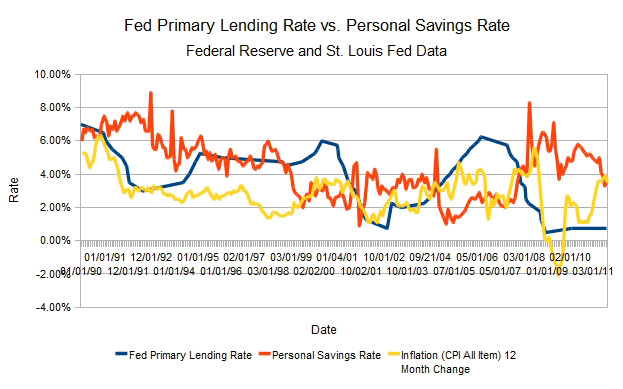
savingsratediscountwindow The Government is Stealing Your Savings.  Seriously.  (Read This to See How!)How Much is the Government Stealing?

Yeah, we know, stealing is a strong word (maybe ‘taking out of the economy’ is better?)!  We know that this policy is in effect in order to increase the increased mobility of money – to stocks and other investments or to encourage spending.  As Mr. Higgs points out, you can get a rough idea of the amount of money the government is taking with this policy by applying a rough real rate of return to the non M1 component of M2 (those are fancy names for the estimate of ‘money’ in the economy).  So, if the Fed Primary Rate is .75% let’s assume that the rate on short term funds is around 1% for simplicity.  Let’s say that the marginal tax rate averages 15%.  The 12 month inflation in October 2011 was 3.5%.  So 3.5% – .85% = a real negative return of 2.65%.  Note that the last time this ratio was negative was in the early to mid 2000s – and that culminated in a massive real estate bubble popping which is still being felt.

M2 – M1 leaves us with an estimate of $9618.8 – $2135.5 Billion in funds or $7.4833 Trillion in short term deposits economy-wide.  Through this policy – rates below inflation and taxes – the government is removing (or stealing, or taking…) $198.307 billion from the economy annually.

So… what do you think about this policy?  Do you think that this is a good thing – encouraging movement away from short term safe savings to alternative asset classes?

Posted by PK on February - 22 - 2012
      

+ Go to Comments Now

Like what you see? Connect by RSS Twitter Facebook Newsletter


  • http://www.20sfinances.com 20sFinances

    Great point. Yet, if it is sitting an a savings account earning very little (and inflation is high), wouldn’t it be your fault for not keeping up with inflation? While it still doesn’t seem right, it’s not the fault of the govt. (unless I am missing something)

    • http://www.dqydj.net/ PK

      Well, it’s a matter of perspective. My argument is that the Fed’s artificially low rates have forced capital flows away from savings accounts. If an account is yielding 1% due to policies of the government and inflation is going at 3% a year (also due to the government at some level…), is that Grandma’s fault?

      It depends on how much credit you assign to the Fed for the savings rate (the Fed sets the Primary Credit Rate, which will affect the savings rates at banks) and inflation (as part of the Fed’s dual mandate they are supposed to moderate inflation).

      So it’s a convoluted answer… but it is environments like this one (January’s 12 month inflation was ~ 2.9% while savings accounts are around 1.0%) which cause people to make unnecessarily risky purchases for their investment horizon. Now maybe I was being facetious saying Grandmas buying pork belly contracts, but it certainly can blow bubbles in odd asset classes.

      Thanks for the question!

  • http://www.thadthoughts.com/ Thad Puckett

    I have a friend who constantly reminds me that the power of the government to tax is the ability to take your money with a gun.  Seems harsh, but the truth is when government grows ever bigger it does exactly as you say.  Much to think about in this article.  Well written.

    • http://www.dqydj.net/ PK

      I suppose that maybe it’s a “How to Create a Bubble” article?

      On Government using force – that is true, but isn’t force the reason we have government in the first place? Government is supposed to be a neutral force-applicator… you know, defending a country, enforcing contracts, keeping order…

      Yeah, granting the government the ability to use force is bad, but I think it’s preferable than allowing everyone to enforce their own contracts. A lesser evil, perhaps?

  • http://moneymamba.com/ JT

    This is single-handedly the most important thing (things?) to understand about investing – rates of return mean nothing until a real rate of return, less taxes, is found for any investment.  The markets are very good at pricing in taxes – lower yields for munis, for instance – but I fear individual investors miss repeatedly in adjusting their own exposure.

    As for the question, I think it’s a great thing!  What better way to finance programs like Social Security and Medicare than with inflation?  In many respects, Social Security and Medicare are paid for with what is an excise tax.  That is to say that people who pay the highest “inflation tax” are much more likely to be recipients of government social programs.  If we can tax gasoline for roads, why not tax risk-free investments used primarily by recipients of social welfare to finance said social welfare programs?

    P.S. The pork belly futures were delisted by the CME Group.  Such a shame too, as it was always my preferred futures contract when I needed an arbitrary financial product to throw around.  RIP pork bellies, 1961-2011.

    • http://www.dqydj.net/ PK

      Man, if pork bellies are gone how are Grandmas going to make any money? I also seem to remember one current Secretary of State doing pretty well for herself in the pork market. It’s a sad, sad end to an era.

      With Social Security, here’s the cycle we’re in: receive check, deposit, get a negative real return, pay tax on that return, pay tax on Social Security benefit (well, for some recipients!). That’s pretty sneaky… if you ask me.

      Cameron pointed out yesterday that the United States is actually borrowing at less than 0% because of inflation. That’s not bad, haha!

  • http://www.101centavos.com/ 101 Centavos

    Thieves, knaves and counterfeiters.  Regular folks get jailed for the stuff the FedGov does.  No need to apologize, a masterfully written post.

    • http://www.dqydj.net/ PK

      Appreciate it!

  • http://changeathing.com/ Baxter

    Fascinating stuff.  Where do you see opportunity for private investors in a climate of lowered interest rates?

    • http://www.dqydj.net/ PK

      Not in fixed income? I think CDs and most banking products are a tough sell outside of money that you need the liquidity (so another mark against CDs…) for, like in an emergency fund. The problem is if the Fed keeps it up, eventually a bubble will be blown somewhere, it’s just tough to predict where or even to see it as it happens (but in retrospect the Real Estate bubble seems obvious).

      Personally? Equities and a decent allocation of real estate, but I’m probably just as directionless as most. I just feel that even after 100% gains from the market bottoms we’ve still got room to run.

      Last time it was Real Estate,

  • http://myuniversitymoney.com/ My University Money

    Wow… I had to re-read that about 3 times.  Very informative post… and here I thought that government involvement always made things more streamlined and efficient ;)  

    • http://www.dqydj.net/ PK

      Haha, I hope I didn’t write it in too confusing a manner – JT gave a good summary when he said ‘real returns matter’. Any time a Fed program forces real returns to be negative? Money seeks out a higher return (or money gets taxed and sits in banks – where there are basically no tax breaks).

  • http://www.mastertheartofsaving.com/ Jen @ Master the Art of Saving

    I always knew “they” were out to get me, but now they’re apparently out to get my money too. :-(

    • http://www.dqydj.net/ PK

      “They’re” the worst offenders!

  • http://www.thefreefinancialadvisor.com/average-joes-money-blog/ AverageJoe

    Ben Bernake tackled this point last week during an interview, when asked a question on this very topic…that people were forced into other savings vehicles. He colored it as a necessary evil to pump up lending to jumpstart the economy.

    • http://www.dqydj.net/ PK

      You know those necessary evils…

      …as Cameron pointed out to me, it’s like paying off the debt for free. Borrow at 2%, inflate at 3%!

  • http://twitter.com/MoneyTrail MoneyTrail.net

    Hmmm…did my taxes yesterday and now this?  Think I am going back to bed!

    • http://www.dqydj.net/ PK

      Haha, no outrage?

      It’s likely too wonky a point to cause anyone to grab their pitchforks. However, it’s definitely an issue – if you have money in a bank you’re losing around 2% a year.

  • Pingback: - Married (with Debt)

  • http://www.myjourneytomillions.com Evan@MyJourneytoMillions

    The amazing part is that the banks have the power to provide a real negative yield (and people flock to do it) yet they still can’t keep themselves a float.

    • http://www.dqydj.net/ PK

      Haha, too true, even now in a bunch of places. The same things happened to the unsophisticated Savings and Loans – when borrow at 3%, lend at 6%, golf at 3:00 PM wasn’t good enough and they took on too much risk.

      But – what sort of leverage would you allow the banks if you made the rules? Would you cap it at a certain amount?

  • Pingback: Weekend Reading: Snow Storm Edition | Invest It Wisely

  • Pingback: Best Tips for Saving Money - Tag You're It Edition - The Frugal Toad

  • Pingback: Sunday Evening Post(s) | Thad Thoughts

Switch to our mobile site