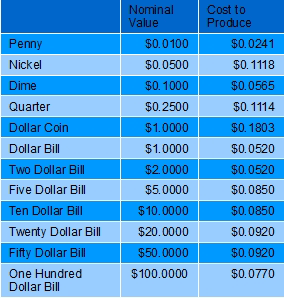

Seignorage is the income a government earns when it coins money or prints bills. The raw materials that make up coins and bills are different than their accepted value, causing this interesting effect.
A special case of seignorage is sometimes coined "reverse seigniorage". This happens when the raw materials in a coin or bill are worth more than the nominal value of the coin or bill. In this case, a government loses money when it produces a denomination.
What's seignorage like in the United States?
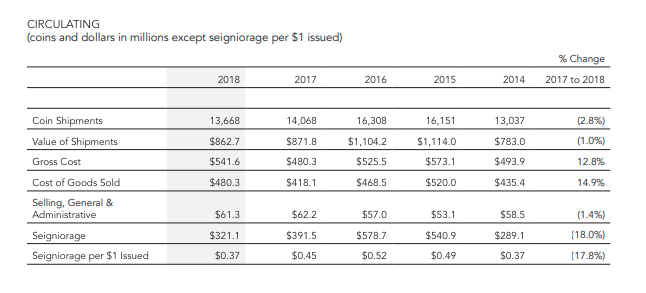
Every year, the US Mint releases an annual report summarizing its currency operations. In 2018, the Mint transferred $265 million dollars to the Treasury general fund as a result of seignorage. It booked $321.1 million overall in seignorage.
What does a penny and nickel cost to create?
Interestingly, due to commodity prices both a nickel and a penny cost more to create than their accepted nominal value.
- Penny: 2.06 cents to create (1.78 cents in materials, .28 other)
- Nickel: 7.53 cents to create (6.59 cents in materials, .94 other)
That's up from 1.82 cents and 6.60 cents to create in 2017.
How can coins cost more than face value?
When coins cost more to produce than their face value, this is where reverse seignorage comes into play. Every coin a Mint produces will cost the country.
There are two effects of inflation which hurt small denominations:
- Inflation makes things more expensive so you need more of a coin to purchase any item.
- Inflation makes the commodities in coins more expensive, increasing the cost per coin.
How countries deal with the issue varies. The United States (in 2019) still has both nickels and pennies. In Canada, while pennies remain legal currency the Mint no longer produces them.
Is it illegal to melt coins?
The legality of melting coins varies by country – and by denomination.
In the United States, 18 U.S. Code § 333 makes it illegal to deface or destroy currency:
Whoever mutilates, cuts, defaces, disfigures, or perforates, or unites or cements together, or does any other thing to any bank bill, draft, note, or other evidence of debt issued by any national banking association, or Federal Reserve bank, or the Federal Reserve System, with intent to render such bank bill, draft, note, or other evidence of debt unfit to be reissued, shall be fined under this title or imprisoned not more than six months, or both.
18 U.S. Code § 333
So don't get any funny ideas about melting down pennies.
Other Interesting Effects of Seigniorage
Hopefully, you can see seignorage is actually a very interesting form of income for a country. Mints have the incentive to create more currency and send revenue back to their respective Treasuries.
You could say: when they print money they print money. Or something.
Mints try to work the demand side, as well. Take the US Mint, for example.
The US Mint encourages collectors to pull money out of the market year after year by issuing collectible coins. If collectors buy them, the US succeeds in two places:
- The Mint captures any immediate seignorage income while creating the coin
- If collectors never spend the denominations produced, the Mint also successfully put money out of circulation
So, often coin collecting means the government receives immediate income and benefits from the second order effects of reduced circulation. Pretty neat!