
• About / Contact
  • Calculators and Visualizations
  • Economic Concepts
  • Advertise
  • Disclosure

DQYDJ.net

Don't Quit Your Day Job: The Intersection of Personal Finance, Economics, and Politics.

RSS
  • Personal Finance
    • Debt
    • Retirement
    • Taxes
    • Health
  • Economics
    • Calculators
  • Politics
  • Investing
  • Offbeat
    • Weekender
    • Books
    • Music
    • Sports
  • Real Estate
    • Bay Area
  • Technology

Who Paid Income Taxes in 2009? The Generational Warfare Edition!

Posted By PK    Last updated December 1st, 2011 22 Comments

Been reading DQYDJ for a while?  Good.  You know that looking at data from a different angle yields very interesting insights.

Here’s one interesting thing: the federal income tax code benefits 18 to 35 year olds at the expense of 45 to 65 year olds.  How do I figure?  The IRS helpfully posted data for 2009 (links are xls files) on both the amount of income made by age group and the amount of Federal income taxes paid after credits.  So, should the Silent Generation and Baby Boom Generation be mad at Generations X and Y?  Partially!  Read on.

Share of Income Made and Taxes Paid

Here is a beautiful graph of the total income tax burden, sliced down into 10 year tranches.
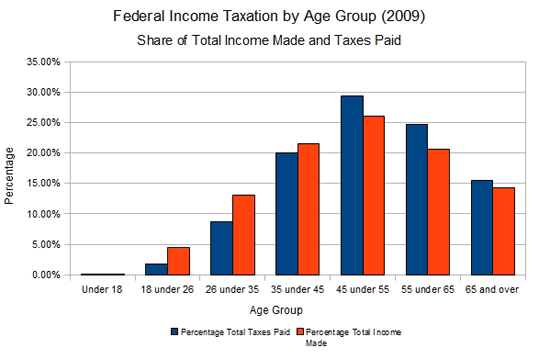
2009 US Federal Taxation Burden by 10 Year Age Group Range

2009 Federal Taxation Burden by 10 Year Age Group Range

Have You Thanked a Baby Boomer Today?

The Baby Boomers get a bad rap – they assume a huge amount of the power positions in the House of Representatives, the Senate, and the Executive Branch (President Barack Obama was born in 1961).  However, since they fall in the ages 45-65 in 2009, that would mean the Baby Boomers (well, and the last year of the Silent Generation) were paying the majority of taxes in the country (54.06%) while earning less than half of the income (46.61%).  Additionally, Baby Boomers receive less in benefits than do the other generations.  As noted in this Special Report from the Tax Foundation,

America’s youngest households aged 25 and under received $2.32 in government spending for each dollar of taxes paid in 2004. Middle-aged households aged 45 to 54 received $0.73 per tax dollar, and America’s oldest households aged 75 and over received $4.93 per dollar of taxes paid.  (Read the rest)

Even more interesting: a vast amount of the payments that go into those federal programs are from payroll taxes, as opposed to income taxes as detailed in the chart.  So, in a nutshell, the Baby Boomers should be mad at everyone.  However, the whole world is mad at them, and they are shouldering the blame.  Isn’t it funny how that works?

So, are you ready to put away the hatchets you’ve got aimed at the Baby Boomers?  Or are you convinced that they set it up this way so they should shoulder the blame?  Fight/comment away!


If you enjoyed this post, let others know!


Filed Under: Economics, Taxes Tagged With: baby boomers, generation x, generation y, silent generation, Taxes

DQYDJ Email Newsletter

Like what you see on this post?

Get the new stuff before everyone else. Sign-up below.


Follow @twitterapi


  • http://twitter.com/retirebyforty retirebyforty

    65 and over really made more money than 26-35? Why are the older generation paying more taxes? Is it because they are in a higher tax bracket? They probably have less write offs too, all the kids are out of the house and the mortgage is gone.

    • http://www.dqydj.net PKamp3

      Yeah, it would be a combination of the number of people in the workforce and the amount of income they earn.  So someone making $60,000 will pay a lot more in taxes than two people making $30,000, for example.  Plus 65 and older covers more years – there actually are (believe it or not) a fair number of people over 75 still working.  Interesting stuff!

  • http://moneymamba.com JT

    America’s youngest households aged 25 and under received $2.32 in government spending for each dollar of taxes paid in 2004  
    We’re stockpiling for when it gets taken back after Social Security’s deficit widens further.  Actually – wait, we’re only talking a Federal Income taxes?  No FICA?  Pfft – if America’s youngest households get more than paid into the system, then if we include FICA they’ll shift disproportionately to the other side.  Shoot – my first dollar is taxed at near 20% after FICA + state.  Once you start adding on the brackets it’s like I’m a millionaire or something!  FICA is enormous!

    Also, man – 2004 dude. Overnight rates were like 1.75% on average, 10x higher than today.  Treasuries were probably yielding…oh, IDK, an average of 4%+ on the 10 year?  I’m not buying it, because then I’d have to stop complaining about old people.

    • http://www.dqydj.net PKamp3

      The top portion is all income taxes, but the part where I quote the Tax Foundation has data which includes payroll taxes.  I know, it seems strange, but the transfer payments are in areas which might not be obvious.  Here’s what they list:

      “Young and middle-aged households are targeted with the most spending on public schools, childcare services and welfare payments, while elderly Americans are disproportionately targeted with spending on old-age programs such as Social Security and Medicare.”

      So you can certainly still complain about old people!  It’s just that “old people” aren’t taking the payments for public schools and universities (and probably not childcare services, heh), they’re taking the payments for social security and medicare.  And yes, those programs are more unsustainable than the ones taken advantage of by the younger subset, haha.  To be more specific, the report later mentions that households aided by those under 25 do most of the lifting on transfers.

      And yes, 2004 is pretty stale at this point, haha!  I was looking for something newer but I failed.  I imagine that even if the exact numbers have changed, the shape of transfer payments is probably still a ‘U’.  If you can find something out there from 2009- today I’d be much happier, though!

    • http://www.dqydj.net PKamp3

      Also – here’s one way to stay mad at the Boomers… you could argue that they are the ones who set up the system with the benefits so heavy in the 65+ area.  Even though they aren’t at that point yet (well, the front end is, maybe), the benefits are going to be huge over the next years… delayed gratification!

  • http://financeservices.biz Marks Spencer

    The percentage of Americans not paying federal income tax has grown to
    around 47%. That number has been growing larger and larger each year
    thanks to numerous tax breaks and credits that have been added to the
    tax code over the last several decades. But that doesn’t mean almost
    half of Americans aren’t paying federal taxes.

    • http://www.dqydj.net PKamp3

      No – the payroll tax is definitely a factor in the pay of many people.  I don’t know if I would say everyone, because there is a subset with so called “under the table” jobs that doesn’t pay tax.  Some taxes can be avoided if goods and services are paid for ‘in cash’ – but yes, your point remains.  More than 53% of people do pay some tax.

      What do you think the proper number would be?

  • http://www.newlywedsonabudget.com/ Newlyweds on a Budget

    Well I’m barely getting a handle on this stuff, but it’s great to see an informed perspective on it!

    • http://www.dqydj.net PKamp3

      I guess the short point: Baby Boomers pay more in taxes than any other generation, and they (currently) take less money out. In a few years they’ll probably be taking plenty, however!

      Thanks for stopping by!

  • http://twitter.com/101centavos 101 Centavos

    Sure, but the younger households are going to get stiffed on Social Security down the line,so it all works out.

    • http://www.dqydj.net PKamp3

      Yep – if it’s there. The most likely scenario is a decrease in promised benefits, probably with some combination of age and inflation related criteria changes. Gotta mess around at the margins, right?

  • Andy Hough

    I don’t think it is too helpful to blame an entire generation for anything.  Multiple generations will have to make some sacrifices if we’re going to reduce the deficit.

    • http://www.dqydj.net PKamp3

      True, and I agree. The amount of Boomer blame is nuts – this is a shared problem. Unfortunately, I think that the solution will be shared by the younger generations, probably starting with Y (X is smaller than Y, so they might be able to skirt…).

  • http://squirrelers.com Squirrelers

    It’s a natural function of earning power and over financial position, to have a graph such as this. No reason for any one generation to get mad at another. I say that keeping in mind that the younger generation likely won’t get the Social Security benefits that the older generations will (or might).

    • http://www.dqydj.net PKamp3

      Yeah – the 40-50 crowd will have the highest average earners, so it is likely they will pay the most tax. I guess my point is that the “40-50 crowd” is mostly Boomers… for all the negative press that generation gets, we need Boomers right now.

      I don’t see any politicians denying benefits to the Boomers, however. That voting bloc is massive and Generation Y just doesn’t care enough to line up on the other side. If anyone gets the shaft it will be younger folks who can’t mobilize against cuts or folks who can’t yet vote – maybe the under 18 crowd?

  • anonymous

    I would love to see a comparison of what the baby boom generation was able to make in equivalent spending power compared to what these age groups are making right now. College meant more back then. If you went you earned more then. So now that you have so many 25 year olds with college degrees can you really compare the 25 year olds to the baby boomers when they have experience that is often rare at just the right time to have it. Also it would be interesting to compare necessary expenses then compared to now. Who could apply for many of the jobs without sacrificing time during the day to go to the library or having a computer with internet access.

    • http://www.dqydj.net PKamp3

      That sort of analysis opens up all sorts of problems – what deflator should you use? (I know some people hate CPI, for example). What age groups should you analyze?

      Let me look into it. I’m thinking the 24-30 crowd with and without degrees from, let’s say, 2010-2011 and 1980-1981, using CPI and perhaps another deflator (I know some people hate CPI – and it doesn’t count ‘quality’ and ‘new goods’ well), and let’s just use car prices and home prices. Do you think that’s a fair article?

      • Daniel Rockel

        I think using the early 80s as a reference point would give a false correlation. The Baby boomers who the Millenials will be paying for according to United States census bureau places the years for the baby boom generation as being from 1946 to 1964 that would put them between the ages of 47 and 65
        This means they would have been in the 25 demographic between 1971 and 1989.
        Choosing the early 80′s as your sample puts the data right there in the middle of the recession we came out of under Ronald Regan. We yet do not know when/ if we will come out of this recession as quickly and prosperously as the 90′s as opposed to the 30′s. could we use the 70′s or the late 80′s as our sample rather than 80 and 81?
        I have no objection for a baseline to compare housing and car costs then to now for purposes of inflation calculation.

        • http://www.dqydj.net PKamp3

          Okay – there’s no need for me to be lazy. Let’s do 24-30 year olds from:

          2011 (Today – Obama)
          1989 (CPS Data is March – so Bush I)
          1971 (Nixon)

          We’ll do:
          * CPI Inflation (or PCE? Boskin? I’ll use a couple)
          * Home Price
          * Car Price
          * Income
          * Debt per capita, if I can find it

          I’m pretty sure today will turn out on top for income, but we’re almost certainly behind on debt. We’ll see how the others shake out (although I’m thinking we will still be better off today – this will be interesting).

          Thanks for the article idea!

  • http://www.facebook.com/profile.php?id=100002637635109 Frugal Toad

    It makes sense that 45-55 would pay the most in taxes as those should be the highest earning years, although our income has been flat over the last several years and has declined in after-tax dollars. 

    • http://www.dqydj.net PKamp3

      Since 2008 we’ve come down a little – some of that is the drag of unemployment on demand and salaries. But yes, it still holds that the mid-40s toe 50s is where most of the money is in a career.

      I made the point in another article that it’s better to make mistakes when you’re younger – financial mistakes are harder to ‘earn out of’ when you’re in that top bracket. Thanks for your remarks!

  • http://www.nextpay.com/ Merchant Account

    Those number definitely tell something but what’s the point of blaming one generation? We are all trapped in this system. Eventually the 35 and under will reach retirement age (some might not) and the cycle goes on and on.

    65 and older have higher income than 35 under because they had good productive years. Decades ago, keeping up with savings and emergency funds are not as difficult as it is now. I wonder how will the graph look 15 year from now..?

    Best regards,
    Belinda

RSS Twitter Facebook Email

Connect

Subscribe to DQYDJ's RSS or Email feed:

Newest on DQYDJ

  • Why Everyone Should Care About Privacy
  • The Stacking Benjamins Podcast
  • The DQYDJ Weekender, 5/18/2013
  • The Saturday Powerball Drawing: You Do Not Have a Positive Expected Value!
  • Predicting S&P 500 Closing Prices – May, 2013

DQYDJ’s Greatest Hits

  • Substitution vs. Income Effect (and its Implications)
  • Give Me Your Wallet! A Visualization of IRS Tax Collection, 1960 – 2010
  • The Earth Is Flat! Why a Flatter Tax Code is Better (The No Math Edition!)
  • Uncle Sam the CEO: Visualization of IRS Revenues Collected 1960-2010
  • Dr. S&P or: How I Learned to Stop Worrying About the Credit Rating Downgrade
  • Is It Possible to Beat The Stock Market?
  • Athletes are Underpaid: The Economics of Player Salaries
  • Must Reads for Serious Thinkers: The Minimum Wage Crushes the Teen Employment Rate
  • What is the Net Worth of Members of Congress?
  • S&P 500 Return Calculator

Sponsors


Online - Save 15% on H&R Block At Home ProductsTurboTax is Easy, Free Edition, Fast RefundProud Member of YakezieInvest Some Savings in a Peer to Peer MarketplaceAdvertise on DQYDJ

Links

  • So Over This
  • The Millionaire Nurse Blog
  • Control Your Cash
  • My Journey to Millions
  • Money Mamba
  • The Free Financial Advisor
  • Careful Cents
  • Political Calculations
  • Burbed
  • The Frugal Toad

Return to top of page

Copyright © 2013 Don't Quit Your Day Job...

Some links on this page are tied to affiliate programs. See our disclosure page for more information.