
• About / Contact
  • Calculators and Visualizations
  • Economic Concepts
  • Advertise
  • Disclosure

DQYDJ.net

Don't Quit Your Day Job: The Intersection of Personal Finance, Economics, and Politics.

RSS
  • Personal Finance
    • Debt
    • Retirement
    • Taxes
    • Health
  • Economics
    • Calculators
  • Politics
  • Investing
  • Offbeat
    • Weekender
    • Books
    • Music
    • Sports
  • Real Estate
    • Bay Area
  • Technology

Is Dave Ramsey’s Investment Advice Misguided?

Posted By PK    Last updated March 26th, 2013 39 Comments

Editor: We’ve since put our S&P 500 trailing returns calculations into a tool you can use.

Dave Ramsey is a controversial figure in the Finance realm, at least in blogs (and blog comments), discussion boards, and other mediums where personal financial mathematics are discussed.  However, Ramsey’s controversy doesn’t generally come about from his investment advice – most of the push-back comes from his advocacy of a psychological debt payoff method known as the “Debt Snowball”.  The Debt Snowball is a form of debt pay-down where you pay off your debts in the order of the lowest account balances regardless of APR (a method which is easily shown to be mathematically inferior to “highest effective interest rate first”.  Psychology?  Beats me.).

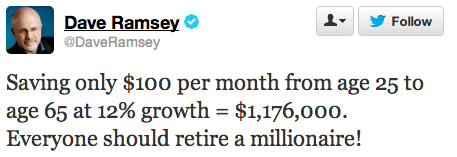
I digress.  Anyway, the battle doesn’t usually extend to Dave’s investment advice.  That’s why I was surprised to see the angry reactions to Dave Ramsey’s recent tweet about how $100 invested a week would turn anyone into a millionaire in 40 years if they averaged 12% returns  (he also later linked to a fund which returned over 13%).  To be exact?  A $1,176,000aire.

Saving only $100 per month from age 25 to age 65 at 12% growth = $1,176,000. Everyone should retire a millionaire!
February 12, 2013 5:26 am via TweetDeckReplyRetweetFavorite
@DaveRamsey
Dave Ramsey


Who is Dave Ramsey?

Mr. Ramsey is one of the most famous Personal Finance authorsin the field today, and an esteemed TV guest and radio star to boot.  He had a checkered past as a real estate investor and filed for bankruptcy soon after the Tax Reform Act of 1986 passed.  From 1984 through 1996 he was a licensed insurance agent in Tennessee.

His Personal Finance empire is the outcropping of financial counseling he started for couples at his church.  He started to attend seminars and eventually developed his own style and methods… which rounded into the Dave Ramsey cult of personality that exists today.  Bestselling author, radio host, TV personality, Christian?  You better believe that a lot of people have an opinion about him.


Dave Ramsey’s Investment Advice

Most people took exception to Dave’s return figure – the 12% number (here’s one angry reaction from Mandi Woodruff at Business Insider).  Now, the S&P 500 may have returned 16% last year, but everyone reading this obviously still remembers the issues with the stock market a few years ago.  Remember that huge drop?

So, was 12% too optimistic?  Lucky for you, this was a question we were born to answer!

Last year we developed a tool to let you figure out the returns of the S&P 500 over any time period using data provided by Robert Shiller on his website.  Now, that tool is great – but we have better ways to play with that data (namely, by tossing it into a spreadsheet program and crunching some numbers for you!).  Let’s evaluate Mr. Ramsey’s comment with the S&P 500 in mind… the most popular benchmark in the United States, which also happens to have tons of index funds and mutual funds and other ways to invest in it.  It’s fair to say that most people have access to an S&P 500 index fund or some other means to invest in the index’s components.

The S&P 500′s Trailing 40 Year Geometric Average Returns
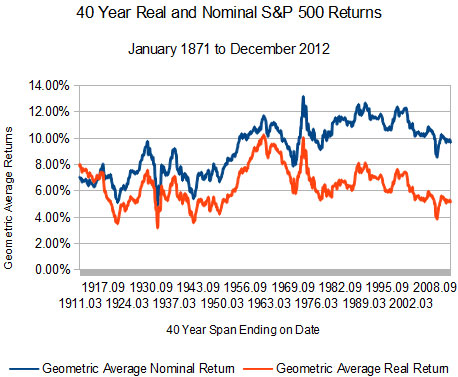
40 year trailing S&P 500 returns.  Real and nominal.

Graphed above are the 1,224 40 year periods in our data-set, which we built by including every month which Shiller had data on dividends and S&P index prices from January 1871 until today (as of February 12, through December 2012).  The number shown is the geometric average return of reinvested dividends over that period, and I calculated both nominal return and real (inflation-adjusted) returns, using the CPI reading also provided by Shiller.  (A note on methodology: if you reproduce the set, when you count dividends makes a difference.  I also assume 0% taxes and $0 transaction fees.  Coase would be proud.)

You don’t even need to see the numbers to recognize that there wasn’t any period in the data-set with over a 12% real return.  There are, however, periods with nominal returns over 12% – 68, to be exact (5.56% of the time).  Here’s a summary of the results:

Nominal Returns Real Returns
Average Return 9.27% 6.42%
Standard Deviation 1.95% 1.39%
Minimum 4.88% 3.17%
Maximum 13.21% 10.29%
Over 12% 5.56% 0.00%
Over 10% 46.00% 0.82%
Over 8% 66.34% 12.09%
Over 6% 96.65% 56.29%

Nominal and Real S&P 500 40 Year Returns Presented in an Ordered Set

Here’s that same graph ordered from lowest returns to highest returns, so you can see just how rare 12% trailing returns were on the S&P 500 over the last 102 years:

S&P 500 Nominal and Real Geometric Average returns, nominal and real, ordered.Now, assuming that most people are talking about the S&P 500 when they talk about the market, it’s just as rare to have 12% trailing returns as returns less than 6%.

Misguided Complaints about Mr. Ramsey?

Okay, so 12% returns are a little too ambitious.  If you retired in December 0f 2012 after 40 years in the markets (defined as the S&P 500, of course) you would have experienced geometric averages of 9.68% nominal and 5.16% real returns.  And, what if you invested $100 a month starting in December 1973 (and reinvested dividends) in a magical fund with no transaction fees and no taxes that tracked the S&P 500 index perfectly (don’t look for that fund – it doesn’t exist)?  I did the math for you – you’d have $636,758.95.

It begs the question, however – why would we get mad at Dave’s tweet encouraging financial discipline?  It seems that, perhaps, you shot for the stars and ended up on the moon.  Isn’t that better than earth?

(And before you ask – goal seek already calculated that to get to $1,000,000 with that fantasy fund you would have needed to invest $157.05 a month).

Dave Ramsey Was Right

Okay, not about the 12% thing.  However, “Everyone should retire a millionaire!” rings true.  If you aren’t investing now, get on it.  I don’t care how you do it – a giant lump sum, periodic monthly investments – just put your money to work for you.

Even if you don’t make 12% over a career, you’ll still have a lot more money than if you try to start a flame war with Dave (or OVER Dave, if you find the right fans) on Twitter.

Although, that would be hilarious.  Link to it here if you can pull it off.


If you enjoyed this post, let others know!


Filed Under: Featured, Personal Finance Tagged With: dave ramsey, inflation, nominal returns, real returns, Retirement, S&P 500

DQYDJ Email Newsletter

Like what you see on this post?

Get the new stuff before everyone else. Sign-up below.


Follow @twitterapi


  • http://twitter.com/BeatThe9to5 Robert Farrington

    I think 12% is a total stretch – but I work the opposite end of the spectrum for my retirement and assume AAR of 4% – 6% in equities. I compliment poor returns with increased savings.

    Dave Ramsey was not wrong about the math, but you know what, even using a realistic number like 8% still gives a solid return over time!

    • http://www.dqydj.net/ PK

      If I spent 40 years saving $100 a month and ended up with $650,000… I might be mad for a few minutes, but then I’d recognize that, hey, that’s not so bad.

      I did the math for you – 100% of 40 year trailing periods returns 4% nominal, and 97.79% did it for real returns. Hopefully, that means you’re safe (but history is no guarantee of future returns, blah blah).

  • Jose

    I think Dave Ramsey’s message may have been lost in the unrealistic expectation of a 12% return. The message is the same that I try to drive in my young adult children. Save often and start young. That way,when you’re my age, you won’t be stuck in a job that you “Have” to have, you can work at a job that you “Want” to have.

    • http://www.dqydj.net/ PK

      Yea, like my comment to Robert – you might have been mad if you started back in 1972 and ended up with $650,000 – but you’re still way ahead of the game. Save early and often and all that jazz… it works, even if not at 12%.

  • http://twitter.com/JohnnyMoneyseed Johnny Moneyseed

    The worst of his tweet is that it gives false hope and encourages extremely low savings standards a 40 year period. $100 will make you a millionaire? That’s just a little dubious.

    • http://www.dqydj.net/ PK

      I want to give Dave the benefit of the doubt – but the last time there were 12% nominal trailing returns on the S&P 500 would be if you started saving in 1960 and retired in November, 2000. Still – I didn’t go back and do market timing on that (although I might put a calculator together in the future.)

      • http://twitter.com/JohnnyMoneyseed Johnny Moneyseed

        He got me into personal finance. And I had a delusion for years that you could milk the S&P500 for 12% annually, and while it has done pretty well the past few years, I think a more realistic expectation for growth over time is 7%. There’s no math behind that estimation whatsoever, it’s just not as lofty as anything in the double digits.

        • http://www.dqydj.net/ PK

          I did the math for you with the theoretical no-tax no-transaction-fee S&P fund – 83.5% of the periods had nominal trailing returns over 7%, and 33.0% had real returns over 7%.

          Safer than 12, for sure…

        • http://twitter.com/Yakezie Yakezie

          Johnny, did Ramsey make you believe you could get 12% annually? If so, for how long?

  • JT

    I want to live in a world with 12% annual stock market returns with 2-3% inflation. Life would be good.

    • http://www.dqydj.net/ PK

      Last time you say 12%+ nominal with 9%+ real? If you started investing in 1933 and retired in March, 1973. 12.44% nominal returns and 9.02% real returns (sorry, inflation ate a bit, but I assume that’s acceptable?).

  • http://www.thebudgetingtool.com/ Mochi & Macarons

    The only thing I’d take offense to, is that he’s tweeting these facts about saving $100 per month and being able to retire a millionaire at 12% returns. It’s just plain unrealistic and false to say this to people who really need the help.

    I would have been happier with: “starting to save with even just $100 a month will get you ______ at the age of 65″. But don’t start tacking on millionaire statuses on savings that won’t get you there.

    By my calculations, people need to save at least $10K a year for about 40 years to secure (real not nominal) millionaire-ship or $833.month, but that’s unrealistic for a lot of lower-income families.

    • http://www.dqydj.net/ PK

      What return are you using? (I know, I know, go ahead and accuse me of being lazy and throwing it in Excel). The last 40 year real return on my chart is 5.16%, so I assume you’re a bit closer to accurate than that tweet.

      I do, however (and maybe it doesn’t come across in the article), love the work Ramsey does – sure, his methods aren’t the mathematical ideal, but he can legitimately claim that he’s put more people on the right path than PK at DQYDJ. (So far…)

      • http://www.thebudgetingtool.com/ Mochi & Macarons

        I use 5%. I never like to go above it, because you just never know.

        Ramsey has definitely helped a lot of folks, but sometimes…. he goes a bit far. I know we can’t say certain things to discourage others to just start trying, but it doesn’t help to give them false hope.

        • http://www.dqydj.net/ PK

          4.88% minimum nominal, 3.17% minimum real – why not 3.17%?

          Haha, I wouldn’t either. I think modeling based on 4-6% is certainly justifiable.

  • freeby50

    I think the problem here is that with too high of expectations it actually gives people justification to save less. Say I’m figuring out how much to put in my 401k. I do a little math, plug in Ramsey’s 12% annual returns and it gives me a number. I then save that much each year thinking this will be enough. But then the market doesn’ hit 12% returns and I end up retiring short of my needs. You can easily have pepole look at that quote and then decide that saving $100 a month is enough since it will make them millionaires, but saving that little is actually going to result in pretty meager retirement savings in the end. Ramsey’s message might help someone who’s saving $0. But its not likely to help anyone saving $100 or more and in fact will likely give them unrealistic expectations and could end up backfiring and hurting their retirement planning & savings.

    • http://www.dqydj.net/ PK

      Yeah, you’re right. I can imagine a scenario where someone saves $100 a month and doesn’t adjust for inflation, then comes up short on their retirement plans. I am sympathetic – there is only so much you can convey in a tweet, but I wouldn’t have lead with 12% – that’s unnecessarily optimistic, and the last time the S&P saw 12% trailing returns was December 2000.

      Plenty of time to change the applause line.

  • freeby50

    I’d imagine people get mad at Ramsey for this kind of thing more because he’s supposed to be an expert and he’s giving advice that is misinformed.

    Ramsey should know better and he’s misinforming millions of people who trust him.
    Thats why I think people get mad.

  • http://twitter.com/moneyqanda Money Q&A

    Jose’s comment below is right. It is sad that Dave Ramsey’s real message in the Tweet was lost with everyone focusing in on an unrealistic expectation of a 12% return. The true message is that everyone should be saving, save often, and save early. His comment goes to show that we often make excuses that we do not have extra money at the end of the month to start saving. But, if we truly look at our budgets and priorities, then we can find the means to save early and save often to reach $1 million and more.

    • http://www.dqydj.net/ PK

      In the interest of deflecting the haters/doubters/non-savers, he should revise his numbers a bit. I don’t think $1,000,000 at 9.68% nominal returns for $157.05 a month is succinct enough, but the numbers need some massaging.

  • Brick By Brick Investing

    I do not believe there is a problem with Dave Ramsey I believe there is a problem with people’s reality. First off I believe Dave Ramsey provides a great service to the personal finance community, he has taken a topic that corporate professionals have made so complex and simplified it for the average person. With that said, I personally cannot stand Dave Ramsey’s “investment” advice. As I stated before he’s fantastic when it comes to personal finance but horrible when it comes to investing. He recommends dollar cost averaging in low fee mutual funds, yada yada yada, now that is fine and dandy for joe blow who wants to have somewhat of a decent retirement but for someone who wants to become truly rich?! Nope, mutual funds won’t cut it. I’ve listened to his podcast thousands of times and heard him slam options or other in depth investment strategies.

    Bottom line, Dave needs to stick to what he knows best!

    • http://www.dqydj.net/ PK

      Unless this site has quite a growth spurt and people take my messages to heart, Dave Ramsey will have done way more for people and their finances than Don’t Quit Your Day Job. I admire the job he’s done, and the results speak for themselves.

      Still, financial sophisticates should pay attention – once friends and family are on the right path, we can do a lot of good by helping them with more complicated topics like asset allocation.

      • Brick By Brick Investing

        Agreed!

  • Sam

    Yeah, 12% is high, but I don’t understand vitriol. The message is to just save and stop spending like an idiot. S

    • http://www.dqydj.net/ PK

      I think I touched a nerve on this one. I agree with the sentiment, though – 12% is a long way from 9%, and people should make more conservative estimates when figuring out something as important as retirement. The difference is $500,000 before fees, haha.

  • JT

    My favorite is that if everyone were to save more to invest, total stock market returns would decline, not go up. Either way, I understand his point, but I really wish he’d get off the 12% number because the people who follow and spread his message rarely fact check for accuracy.

    • http://www.dqydj.net/ PK

      Right – and I’m just insane enough to run the numbers. Revise the numbers, put out the new message (9.5% nominal? 9%? $200 a month?) and get on with it. Even $100 a month is awesome, from the perspective of someone who doesn’t save.

    • Joe

      lol exactly. Asset demand theory FTW. That’s my #1 reservation about using indexing as a singular investing strategy.

      As for Dave Ramsey: as soon as somebody reads his infantilizing “baby step” that instructs them to pay off the lowest balances first rather than highest interest, they should realize he’s not right about everything. He rips on the banks, credit card companies, etc. and then encourages debtors to give them free money.

  • Bichon

    The real controversy is the ELP (Endorsed Local Provider) network where he sells you to a pack of wolves with 5% loads and high fees.

    Greaney made a spreadsheet aka “The Dave Ramsey Endorsed Local Provider (ELP) Shaft Detector”

    http://retireearlyhomepage.com/daveramsey.html

    • http://www.dqydj.net/ PK

      I must say that that is one of the best calculators I’ve played around with – I need to step up my game.

      Thanks for linking that – I didn’t know how the sales loads worked on the mutual funds. I figured that “13%” wasn’t the whole story when I saw the front-end sales charge of 5.75%.

      • Bichon

        Glad you enjoyed Greaney’s SS. He has really good stuff. Unfortunately, it is only 3 or 4 times a year.

        Wait ’till I roll out with my Monte Carlo simulator in native excel (no vba). ;)

        • http://www.dqydj.net/ PK

          What’s the strategy? I thought about doing one in Javascript which has all of the Shiller data inside for monthly returns. However, I don’t know if that’s fair since months aren’t completely independent from each other (150%, -30%, 50%? Probably not going to happen).

          Of course, I might need to toss PE/10 in there or people on the internet might get mad.

  • Julie @ Freedom 48

    I think people got too caught up on the rate of return… and completely overlooked the lesson behind the message. No matter what your rate of return – if you start saving young, and save a set amount regularly… you’ll do well.

    • http://www.dqydj.net/ PK

      He should change his math a little though – $200 a month, 9.5% going forward? Easier to defend than 12%, especially if we haven’t seen that in the S&P 500 for the last 12 years (end of 2000 would have seen it).

  • 101 Centavos

    Looks like Dave Ramsey is having a well-deserved Suze-Orman-debit-card moment here on DQYDJ.net. Such meanies to a unselfish servant of the common weal. :-)

    Neutral on Dave, by the way. Yes, he’s gotten a lot of folks to start thinking the right way about ridding themselves of consumer debt. Yes, he’s a douche for steering them towards mutual funds, and wearing a false expert hat.

    • http://www.dqydj.net/ PK

      Yeah, I don’t know how to approach the math behind the Debt Snowball. “If you were good at math you wouldn’t be in debt”. Good point, Dave.

      The mutual funds though? C’mon. Vanguard, Fidelity, T. Rowe Price? There’s no need to pay absurd loads to invest in stocks.

  • Pingback: Wealth Building Bricks - Session #3 | Brick By Brick Investing

  • Pingback: Sunday Morning Dump: Craigslist, Curling, and Chips - Financial Uproar » Financial Uproar

  • Pingback: Carnival of Wealth, Africans Are Inferior Edition | Control Your Cash: Making Money Make Sense

RSS Twitter Facebook Email

Connect

Subscribe to DQYDJ's RSS or Email feed:

Newest on DQYDJ

  • Why Everyone Should Care About Privacy
  • The Stacking Benjamins Podcast
  • The DQYDJ Weekender, 5/18/2013
  • The Saturday Powerball Drawing: You Do Not Have a Positive Expected Value!
  • Predicting S&P 500 Closing Prices – May, 2013

DQYDJ’s Greatest Hits

  • Supply and Demand (And Other Economic Arguments Against the Minimum Wage)
  • Frugality vs. Reality: Is Frugality Overrated?
  • Give Me Your Wallet! A Visualization of IRS Tax Collection, 1960 – 2010
  • Is It Possible to Beat The Stock Market?
  • Must Reads for Serious Thinkers: The Minimum Wage Crushes the Teen Employment Rate
  • All About Credit Cards and the Perfect Credit Card Spending Strategy
  • Athletes are Underpaid: The Economics of Player Salaries
  • Should Art and Psychology Majors Pay Higher Student Loan Rates?
  • When Stupid Ideas Go Mainstream: Algebra on the Chopping Block
  • Dollar Cost vs. Lump Sum Investing: Where Dollar Cost Averaging Fails.

Sponsors


Invest Some Savings in a Peer to Peer MarketplaceProud Member of YakezieAdvertise on DQYDJTurboTax is Easy, Free Edition, Fast RefundOnline - Save 15% on H&R Block At Home Products

Links

  • Burbed
  • The Free Financial Advisor
  • Len Penzo
  • I Am One Percent
  • My Journey to Millions
  • Modest Money
  • Free By 50
  • The Frugal Toad
  • Hope to Prosper
  • The Millionaire Nurse Blog

Return to top of page

Copyright © 2013 Don't Quit Your Day Job...

Some links on this page are tied to affiliate programs. See our disclosure page for more information.