
• About / Contact
  • Calculators and Visualizations
  • Economic Concepts
  • Advertise
  • Disclosure

DQYDJ.net

Don't Quit Your Day Job: The Intersection of Personal Finance, Economics, and Politics.

RSS
  • Personal Finance
    • Debt
    • Retirement
    • Taxes
    • Health
  • Economics
    • Calculators
  • Politics
  • Investing
  • Offbeat
    • Weekender
    • Books
    • Music
    • Sports
  • Real Estate
    • Bay Area
  • Technology

Don’t Use Leveraged ETFs (Unless…)

Posted By PK    Last updated March 12th, 2012 12 Comments

There is a ticking financial time bomb in the portfolio of many investors, especially those of us with a Day Job. This time bomb is particularly scary because the way the product is purported to work is so different from the way it works in practice. What am I talking about? Well, you clicked the article (or scrolled in your RSS reader)… I’m talking about leveraged ETFs.

Thanks to DQYDJ’s friend JT at Money Mamba for his contribution to this post!

Leveraged ETF Problems & Leveraged ETF Decay

In theory, Leveraged ETFs sound like a great idea to many investors. They work by delivering some multiple of an index’s return in their own return (either by going long or going short that index). So, for example, take the ETFs SSO and SDS:

  • [[SSO]] – “ProShares Ultra S&P500″. Description: “The investment seeks daily investment results, before fees and expenses, which correspond to twice the daily performance of the S&P 500 Index.”
  • [[SDS]] – “ProShares UltraShort S&P500″. Description: “The investment seeks daily investment results, before fees and expenses, which correspond to twice (200%) the inverse (opposite) of the daily performance of the S&P 500.”

So, in theory, these funds are supposed to deliver 2x the return, in either a bullish or a bearish direction, of the S&P 500. In practice, look at this chart of SSO (blue), the S&P 500 (green) and SDS (red):
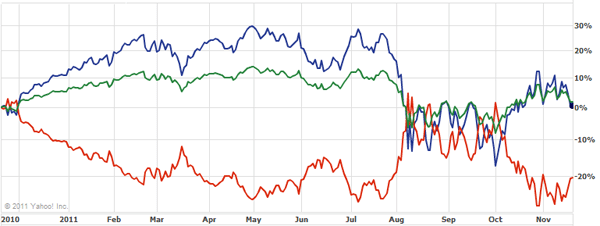
SSO / SDS Leveraged Pair 1 Year Chart from November 24, 2010

SSO / SDS Leveraged Pair 1 Year Chart from November 24, 2010 (Yahoo!)

Even though the S&P 500 is up slightly, SSO did not match the returns of the two times the index. SDS fared even worse – losing more than 20% when the S&P 500 wasn’t up anywhere close to 10%. Whoops!

What is the Constant Leverage Trap?

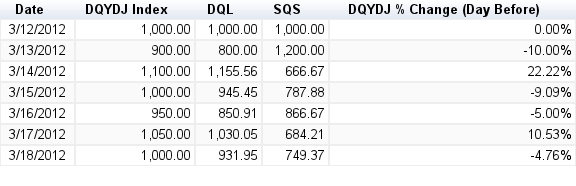
Here’s the main problem with these funds: they are not meant to be held for longer than a day. The key word in the descriptions is “daily performance”. Since the ETFs attempt to maintain a daily leverage of 2x (it could be 3x or some other multiple depending on the fund). So, what you’ve got is an automatic re-balancing problem… the long fund is buying contracts and assets when prices have already increased, while the short fund is doing the opposite. In a day when the market declines, the short fund is selling on a down day. Sell high & buy low is no recipe for success, especially when you’re also paying a management fee. Ignoring a fee, how would that work with some random numbers? Let’s look at 3 random days and 2 random finds. DQL – goes 2x long the DQYDJ Index, and DQS – goes 2x short the DQYDJ Index. Everything starts at 1,000.


Even though the market traded sideways over the 7 days in question, both the short and the long fund lost money. So, what is the constant leverage trap? It’s the reason you shouldn’t hold leveraged ETFs longer than a day… re-balancing assets will erode the value of your fund unless markets follow a strong trend (think increasing every day or decreasing every day.). Markets have a generally positive drift rate, but truly strong trends of the type I’m describing are rare. Note that this analysis is also ignoring the impact of management fees on the funds themselves.

Advanced Market Strategies: Shorting Leveraged Pairs

I suppose I could also have named this section how to make money with the constant leverage trap. This section requires a disclaimer: in no way am I recommending this strategy. I’m just pointing out that the old line that ‘if something is horrible to buy it must be great to sell‘. Do your own research, but consider shorting leveraged pairs.

We decided to cast our net further for an expert opinion and solicited some comments from JT at Money Mamba:

Levered ETFs can be great…for the short-term.  Otherwise, the decay eats investors alive.  As for a pairs trade, it can definitely work in a simulated universe.  I have open pairs shorted in my play portfolio at Fool.com where I’ve become one of the top 1% performing members just because of open shorts on levered funds.   

In a real account, the ability to short a leveraged fund can be limiting.  Borrowing shares of stock is not flat-rate; some require more or less money depending of course on supply and demand.  It’s entirely possible that it would cost you 50% or more per year to short a leveraged fund. (The first short-sellers in Groupon were reportedly paying as much as 90% per year to sell short – and it wasn’t guaranteed to go down in value like leveraged ETFs are!)
Can you make money with this strategy?  Absolutely!  But you’ll have to have the confidence that you can acquire shares to short at a favorable rate.  I’d leave it to the brain-heavy institutional investors who have more brainpower than I do when pricing their investments or lending shares to short-sellers.  This is essentially a volatility play, since you’ll make money only if volatility in the future is higher than expectations (and thus decay happens faster than expected by traders lending shares to short-sellers.)  Otherwise, the cost to short an ETF should be in line with expected decay given the current market volatility.
The people who make the real money with levered exchange-traded products are the ETN issuers.  Imagine how great it must be to sell a note at $100 and know that over time, the odds are that it will go to zero.  The IPO of a new ETN is essentially free money for the issuer, with only minute, short-term risk.  If you launch two levered ETNs going in either direction with roughly the same amount of investment interest, you’ll laugh all the way to the bank!

For a more detailed description of the strategy, see this post on shorting leveraged pairs from blogging friend Darwin at Darwin’s Finance.

Comments

In this strategy, you would short sell the short and the long end of a pair. You would set some sort of a limit on the long side of the pair – remember markets can only fall to zero, but they can go as high as they like. Set your limit at a point where the opposite fund would have gone to zero, and reevaluate it often to avoid the problem described in this post.

If you really want to make money off these products – take JT’s advice and start a financial company to issue these ETFs.  The average investor should stay well away from these money traps.

Do you own any leveraged ETFs?  How have they performed in your portfolio?  Will you be changing your approach?


If you enjoyed this post, let others know!


Filed Under: Investing Tagged With: bad investments, constant leverage, ETFs, financial traps, Portfolio

DQYDJ Email Newsletter

Like what you see on this post?

Get the new stuff before everyone else. Sign-up below.


Follow @twitterapi


  • http://www.thefreefinancialadvisor.com/average-joes-money-blog/ AverageJoe

    Back when I was a practicing advisor, I’d have them in some portfolios, but only for a matter of hours….rarely over a day. That’s why I love this line from JT:

    :…I’d leave it to the brain-heavy institutional investors who have more brainpower than I do when pricing their investments or lending shares to short-sellers…”

    I generally leave these alone and play where I have a better chance of winning (or understanding what the heck I’m doing!)

    • http://www.dqydj.net/ PK

      Brainpower or computer power or bandwidth? I bet we could work through the theory pretty easily, but all the arbitrage that is possible is only useful when you co-locate with NYSE or NASDAQ servers and you run your algorithms with a supercomputer.

      I feel that way about a lot of arbitrage – the trades that day traders used to make have been taken by computers, so trading systems have moved to larger and larger time frames.

      Here’s my system: hold as long as possible.

  • http://moneymamba.com/ JT

    I don’t think I’ve ever owned one…maybe once or twice.  And even then, it was probably something with less day-to-day volatility, or a particular investment that I really thought would have several up or down days.  Those are few and far between – hard to predict direction, let alone a consistent direction for many trading sessions in a row!

    You have no idea how bad I’d love to start levered ETNs for every single part of the market.  It’d be great!  Sit back, relax, and let the power of mathematics slowly make you a really wealthy dude.  Who needs annual expense ratios when all levered funds and notes eventually go to zero?

    • http://moneymamba.com/ JT

      I just had a second thought. You could probably use that options tool you built to find statistical variance in the price of options on levered indexes and unlevered indexes.  If the options-pricing favors one direction substantially, you’d have an idea of which indexes are expected to move up/down in one direction for many trading days, compounding returns each day.  Hmm…

      • http://www.dqydj.net/ PK

        Actually, yeah, you could use my tool to try to un-spin the options on the 2x and 3x ETFs. It’s possible the market prices SPY and whatever 2x/3x ETFs where the ETFs aren’t moving 2x or 3x the index – and by looking at the difference we can guess how many up or down days the market expects on the way to the SPY price! Derivatives of derivatives… but it’s all discrete…

        …You reminded me that I didn’t do a prediction last month. Whoops; feel free to berate me!

    • http://www.dqydj.net/ PK

      Some of the ETNs are interesting because they don’t rebalance daily – which means it’s pretty much WYSIWYG (well, other than bearing the cost of the default risk of the issuing bank). Of course, it would be hard for the bank to go bankrupt on just that product as long as they also sell the opposite ETN…

      • http://moneymamba.com/ JT

        There was one fund company that really embraced this model by creating two levered real estate ETF/Ns (don’t really know how you’d classify it) where the assets were invested only in Treasuries.  Each month, funds would be moved from one side of the trade to the other, long or short, to reflect the monthly change in the Case-Schiller Home Price Index.

        Investors never quite took to the fund.  I guess when you’re honest with your casino, no one wants it.

  • http://www.financialgod.com/ FG

    I agree with JT’s advice. Also, I’m just not experienced enough to play with fire here, so I’ll leave it to others. 

    • http://www.dqydj.net/ PK

      Yeah, I don’t touch them in my portfolio, but maybe they’re useful as indicators?

  • Pingback: Carnival of Wealth, March Winds Edition | Control Your Cash: Making Money Make Sense

  • Pingback: Carnival of Passive Investing #16 | moneyrabbit.info

  • Pingback: Carnival of Passive Investing #16

RSS Twitter Facebook Email

Connect

Subscribe to DQYDJ's RSS or Email feed:

Newest on DQYDJ

  • Why Everyone Should Care About Privacy
  • The Stacking Benjamins Podcast
  • The DQYDJ Weekender, 5/18/2013
  • The Saturday Powerball Drawing: You Do Not Have a Positive Expected Value!
  • Predicting S&P 500 Closing Prices – May, 2013

DQYDJ’s Greatest Hits

  • The Earth Is Flat! Why a Flatter Tax Code is Better (The No Math Edition!)
  • The Four Pillars of Personal Finance
  • Dollar Cost vs. Lump Sum Investing: Where Dollar Cost Averaging Fails.
  • Should Art and Psychology Majors Pay Higher Student Loan Rates?
  • Which Political Demographics Watch Which Sports?
  • Are College Graduates Better Off Today Than in the Past?
  • All About Credit Cards and the Perfect Credit Card Spending Strategy
  • The Fundamental Problem With Financial Models
  • Optimizing Bet Sizes with the Kelly Criterion
  • Is Dave Ramsey’s Investment Advice Misguided?

Sponsors


Online - Save 15% on H&R Block At Home ProductsTurboTax is Easy, Free Edition, Fast RefundProud Member of YakezieAdvertise on DQYDJInvest Some Savings in a Peer to Peer Marketplace

Links

  • My Journey to Millions
  • Careful Cents
  • The Frugal Toad
  • Political Calculations
  • The Free Financial Advisor
  • Hope to Prosper
  • Money Mamba
  • The Millionaire Nurse Blog
  • Your Finances Simplified
  • 101 Centavos

Return to top of page

Copyright © 2013 Don't Quit Your Day Job...

Some links on this page are tied to affiliate programs. See our disclosure page for more information.