
Most of the readers of this article likely don't have access to the sort of exotic investments the Romneys participated in - the Cayman Islands pass-through accounts, the private equity feeders, the partnerships, the unique IRA opportunities - but we do have one old standby we can rely on to always take our funds - S&P 500 index funds! Now, the index we're going to use in this article is a special index - we're investing like Mitt Romney when it comes to maxing out - but putting it in the DQYDJ fund. It trades once per month and it doesn't charge any fees - that's right, it's managed for free. (It's fake, if that isn't obvious...)
Anyway, that lets us do some interesting acrobatics with our fund - we can now use Robert Shiller's monthly S&P 500 return data (AND our assumptions of investment timing by the Romneys!) to make some wild assumptions about how much money you would now have sitting in your tax advantaged funds. Remember - DQYDJ already has a historical real return calculator for the S&P 500. Use that if you want to calculate theoretical returns for a different time period.
(Editor: Romney almost certainly had access to a defined benefit plan as well at Bain, possibly structured in a similar way to this profit sharing plan Bain Capital started in 2008. Even if he didn't, unique IRA opportunities may explain most of the out-performance. This could have increased his cost basis by 2-4x.)
One More Giant Assumption
Recall from that last article that we traced tax laws back to 1975 (when the IRA started) to estimate that the Romneys contributed $612,475 of their own money to retirement accounts before Mitt left the private sector. For this article, we are going to go year by year and divide the contributions into monthly lump sums (each year / 12), then apply the Shiller data. I also assume you've been reinvesting your dividends. Hopefully you're salivating now about these results!
For those of you that want to dig in a little deeper, here's my spreadsheet where I did the math (ODS, should open fine in Excel or Google Docs):
(Editor: Read the note above about cost basis. However, the number is correct if you didn't have access to a defined benefit plan in those years.)
Investing Like Mitt Romney!
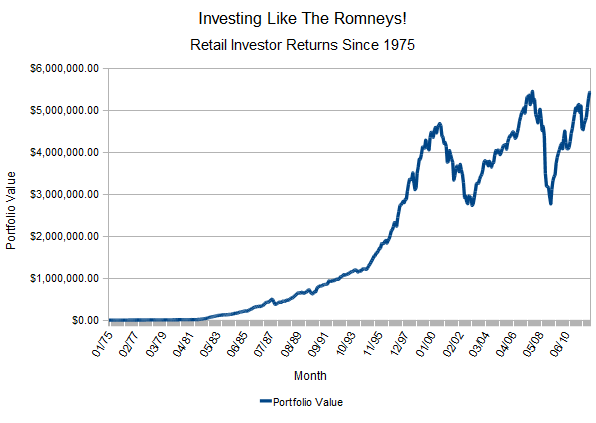
Path for investing like Mitt Romney: well, maxing out and buying index funds
If you had invested $612,475 of your money in the time frame in question (using the assumptions stated above), your portfolio would have been worth $5,436,947.75 in April of 2012. You would have first crossed the 7 digit line in November of 1992 - with 7 more years of contributions remaining. Not bad - but remember, the Romneys said the value of their portfolio was between $20.7 million and $101.6 million. What gives?
That gap of out-performance seems impossibly large - but actually doing the math, you'll see that, as Albert Einstein is rumored to have said, "compound interest is the most powerful force in the universe". If you beat the S&P 500 by 5% continuously, you'd be around $20 million. If the IRA is on the high end? An 11% continuous out-performance gives you around $92 million.
An additional point - I can't tell you what sort of account access Romney had post-1999 - so they may have contributed even more than our original estimate. If you have that data mail me, or comment (only for accounts which could be rolled over into IRAs).
So, You're Saying There's a (no?) Chance?
Well, you knew that Warren Buffett would me making an appearance in this article - Berkshire Hathaway's book value increased at a rate almost 11% higher than the S&P 500 from 1965 to 1975. That includes after Berkshire got so large that it became harder for it to maneuver - it returned even more in the early years.
A few individual stocks - if concentrated - would have beat the S&P's returns. Apple and Phillip Morris (Altria) come to mind. If an investor was lucky enough to pick one of those wagons to hitch to, Mr Romney might even be eating his or her dust.
In essence, you could theoretically match the Romneys with a bit of luck (or, if you accept the arguments, skill). Of note: if you had invested in IBM instead of the S&P 500 would leave you with $13.2 million.
Of course, you'd have a lot more maneuverability if those companies you were invested in weren't publicly facing. Basically, tightly held companies, (while more volatile), may have greater potential of market beating returns. If that wasn't the case why would anyone start a business versus just investing in the stock market? And yes, with a self-directed IRA you yourself can even invest in closely held companies. Just be willing to shoulder the risk, and in 35 years I'll write an article about your finances!
How do you feel about the Romney IRA fortune now? Do you think you can match it in 35 years? Beat it? Do you think investing like Mitt Romney - but with index funds - would work out okay?
