• About / Contact
  • Calculators and Visualizations
  • Economic Concepts
  • Advertise
  • Disclosure

DQYDJ.net

Don't Quit Your Day Job: The Intersection of Personal Finance, Economics, and Politics.

RSS
  • Personal Finance
    • Debt
    • Retirement
    • Taxes
    • Health
  • Economics
    • Calculators
  • Politics
  • Investing
  • Offbeat
    • Weekender
    • Books
    • Music
    • Sports
  • Real Estate
    • Bay Area
  • Technology

Is It Possible to Beat The Stock Market?

Posted By PK    Last updated February 16th, 2013 11 Comments

You recently completed a very verbose series here at DQYDJ on investor psychology, the failure of the Efficient Market Hypothesis, and how to improve on buy and hold.  If you survived all of that, you’re probably wondering: “hey PK!  You mentioned in the EMH article that you trade stocks on valuation.  How do you know that you’re doing the right thing?”

Good point dear reader, and to tell you the truth, until I ran the numbers this weekend I wasn’t quite sure.  However, lucky for you (and my ego) I have now run the numbers and am ready to share my investing history.

A Little Personal Background

Unlike some of you, I can actually point to the date I traded my first individual stock: (because it wasn’t an incredibly long time ago) March 3, 2009, a little bit before I started this website.  It’s not that I’m new to investing, it’s just that for the beginning of my investing career I stuck to mutual funds.  Even today, individual stocks make up less than 20% of my net worth.

I started investing by reading a bit about the Efficient Market Hypothesis and by, of course, completing the most important text on that subject, A Random Walk Down Wall Street.  Yes, the mutual fund portion of my portfolio is still set by what I learned from those days.

Since I only have 38 months of individual stock investing history, my value strategies have really only been tested by two types of markets… the massive bull market which started around when I did, and the side to side trending market of the recent past.  The point?  My strategies (and my emotions) haven’t been tested by a true bear market – even though I did continue to invest heavily in stock mutual funds during the Great Recession.

Enough Caveats!

So, did I beat the market from 3/3/2009 until 5/4/2012?

My return (annualized): 29.93%
S&P 500 Return (annualized): 26.37%

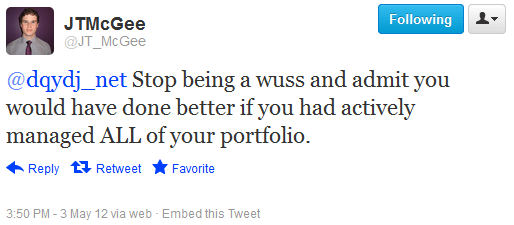
So I’ve been able to generate 3.56% of excess returns per year over the last 1,158 days.  It’s not Warren Buffett’s track record, but hey, maybe I’ll have to invest more in individual stocks in the future (and sell some of those mutual funds).  At least I’ll impress this guy:

Maybe so, but who’s to say I wouldn’t have invested differently had my whole portfolio been on the line?

Methodology

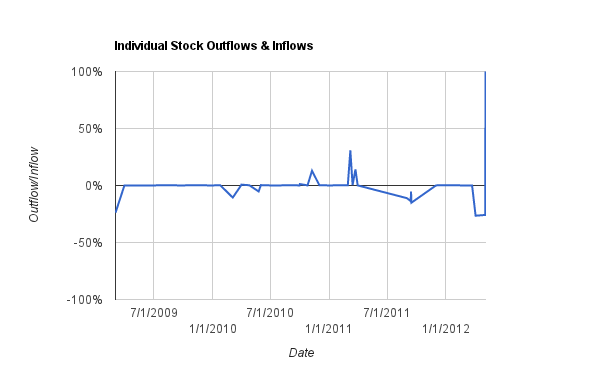
I know that I’d irreparably ruin DQYDJ’s reputation if I didn’t show you how I calculated the return.  The short answer is: use your trading history to set up a spreadsheet in Excel (or OpenOffice or Google Documents) and run XIRR on your cash flows.  Here’s a graph of my inflows and outflows since 3/3/2009 (and yes, I did spend my dividends in the beginning, so you can see them as very small outflows).  Inflows are negative (depositing money to buy stock), outflows are positive (withdrawing money).  The “last” outflow is the current balance – 100% (it doesn’t mean that last Friday I pulled out all my stock, it’s just the value of the portfolio as of Friday at the market close).
As for the S&P 500, this analysis is biased towards it.  Most people use the price return of the index – but that would discount dividends and share options.  I used the S&P 500 total return index, which happens to include reinvested dividends.  On 3/3/2009 it closed at 1126.18, and on 5/4/2012 it closed at 2366.39, for a 26.37% annual return.  See the problem?  You can’t invest directly in an index, so your actual return would be less due to management fees and transactions.  Oh, and you may have spent the dividends.  I’m just saying!

Do you think I’m lucky or good?  Is it better to be lucky or good?  Is it actually unlucky to be lucky when you first start something risky?  Will I regress to the mean?  Should I sell my mutual funds and only buy individual stocks from here on out?


If you enjoyed this post, let others know!


Filed Under: Featured, Investing Tagged With: efficient market hypothesis, pk, stock returns, value investing

DQYDJ Email Newsletter

Like what you see on this post?

Get the new stuff before everyone else. Sign-up below.


Follow @twitterapi


  • http://www.pfblogwatchdog.com/ Bichon Frise

    I think it is possible to beat the stock market.  Peter Lynch being a prime example.  But, with the fees and costs one incurs, the deck is stacked high against a person setting out do this and very few people will consistently succeed. 

    As I stated before, there is no way of knowing ex ante if you are good or lucky.  Let’s get an update in 15-20 years and we’ll see how things are going.  Perhaps the taunting college boy is the next Buffet, and for his sake I truly hope so.  But, by the time we figure that out, I’ll long be into retirement.    

    • http://moneymamba.com/ JT

      Eh, it was a taunt only in the sense that I thought he should release his trading record. I knew he had beaten the market, it’s just that for whatever reason no one wants to say that they can because once you do you get lambasted as a crackpot. And, at least for me, you get the people who write it off as simple naivety with passive references to age, as if it’s just a phase that most people grow out of. As if time spent living on the face of the world translates directly to experience and understanding of the financial markets.

      I don’t care to change anyone’s mind, though I do wish people were better at deciphering evidence to draw conclusions.

    • http://www.dqydj.net/ PK

      I know JT meant it as a joke, in this case, not as an insult. However, just like when someone (in sports) says “if we had only xxx back in yyy”, you don’t know how events would have unfolded if you change the variables.

      What if, with all my money on the line, I bought different stocks and underperformed? What if I tried to buy more stocks and matched the market exactly? That was more my point – like, until I look back I won’t know.

      And yeah, 1,158 days is a pittance when it comes to a track record, and a pittance even compared to my total time investing. My cowriter pointed out to me that because of the levels of variance from day to day in the stock market (read: not too much), some studies suggest upwards of 60 – 80 years are needed to make conclusions with any sort of confidence – and that my 1,158 (now 9!) days may only really represent 3 or 4 data points, haha.

      But hey, in the long run, we’re all dead right? Maybe it’s all luck and it never catches up to me?

  • Paul @ Thefrugaltoad

    Aside from a few individual stocks in an IRA, I stopped trading individual stocks a long time ago.  I quickly and somewhat painfully learned that markets are manipulated by people that have information that I don’t have access to or have a vested interest in creating a buzz about a stock.  More to the point for me was that I simply did not have the time to stay current with the research necessary to know which side of the trade I needed to be on. Currently I consider myself a value investor which works with a buy and hold strategy.  Valuations do change over time so I keep an eye out for opportunities to adjust the portfolio.

    So will we have to wait for the ebook to come out before we see your trading secrets? ;)

    • http://www.dqydj.net/ PK

      Or maybe I’m just super lucky? Thanks for the faith, haha. I just think the sample size at this point is too small…

  • http://youngandthrifty.ca/ TM @ Young and Thrifty

    So here is my deal DQ.  I read stuff by you and JT and it makes me seriously think that there are people bright enough to beat the street.  Then I read a ton of books about the incredible amount of insider information that many huge hedge funds are privy to.  I honestly think it was difficult to compete with Wall Street before.  With high frequency trading and the incredibly blatant information advantage some of these guys have (even Congress appears in on it) I don’t want any part of competing with them.  I’m more than happy to take my average passive investing returns.  I think you have to be both good and lucky if you’re beating the market over a 36+ month window.  I will be very surprised if you have not reverted back to the mean after 10 years or so.  Then again, everything JT posts seems to prove me wrong, so go figure.

    • http://www.dqydj.net/ PK

      Maybe so, and I certainly don’t consider my small individual stock investing period to be a great sample.  I’d like to see at least double the time-frame before I drew any conclusions about my luck or my skills.  Maybe it’s just luck playing with my head?

      I do want to point out that even Sam, who seems to be considered quite a conservative guy, has more money in equities than I do (35% according to this article).  I’ve only got a bit less than 20% of my portfolio in individual stocks, so I’m hedging my bets, haha.  You’re certainly in good company with Buy and Hold, although some people would disagree (see the comments section in any of the posts last week).

      • http://youngandthrifty.ca/ TM @ Young and Thrifty

        I don’t know if I’m buy-and-hold any one specific company (except for a few blue chips like P&G, Wal-Mart etc.), but I am buy-and-hold the entire market.

  • Pingback: Midweek Reading: Exorbitant Privilege Edition | Financial God

  • Pingback: How Do You Know You’re Ready For Active Investing?

  • http://www.nextpay.com/prepaid_debitcard_solutions.php Debit Card Online

    I’m hesitant competing with those big guys at the stock market. Stock market can be viewed as a random walk or Brownian motion where  you can’t predict what will happen exactly after some steps. But personally, I know that stock market is more than that. It’s a huge advantage for those who have connections and get some handful of insider knowledge.

    Best regards,
    Belinda

RSS Twitter Facebook Email

Connect

Subscribe to DQYDJ's RSS or Email feed:

Newest on DQYDJ

  • Why Everyone Should Care About Privacy
  • The Stacking Benjamins Podcast
  • The DQYDJ Weekender, 5/18/2013
  • The Saturday Powerball Drawing: You Do Not Have a Positive Expected Value!
  • Predicting S&P 500 Closing Prices – May, 2013

DQYDJ’s Greatest Hits

  • 45-49 Years Old: The Peak of Your Financial Prowess
  • Dollar Cost vs. Lump Sum Investing: Where Dollar Cost Averaging Fails.
  • Is It Possible to Beat The Stock Market?
  • Supply and Demand (And Other Economic Arguments Against the Minimum Wage)
  • Racial Bias in Foul Rates among NBA Referees
  • Uncle Sam the CEO: Visualization of IRS Revenues Collected 1960-2010
  • S&P 500 Return Calculator
  • How Did Mitt Romney Get a $20.7 Million IRA?
  • Real Bay Area Income and Home Calculator, 2011 Edition!
  • Hedge Your Gas Prices!

Sponsors


Invest Some Savings in a Peer to Peer MarketplaceAdvertise on DQYDJOnline - Save 15% on H&R Block At Home ProductsProud Member of YakezieTurboTax is Easy, Free Edition, Fast Refund

Links

  • The Frugal Toad
  • Control Your Cash
  • I Am One Percent
  • 101 Centavos
  • Careful Cents
  • Hope to Prosper
  • Financial Uproar
  • Free By 50
  • Your Finances Simplified
  • Burbed

Return to top of page

Copyright © 2013 Don't Quit Your Day Job...

Some links on this page are tied to affiliate programs. See our disclosure page for more information.