
The method the government uses to track inflation through the Consumer Price Index is a decent gauge. It tracks the prices an 'average person' in America pays for a particular basket of goods. That said, there are a number of alternative inflation measures which may better capture the ultimate value of your money - now and in the future.
Perhaps an overly strict index isn't the best choice?
What's wrong with a basket of goods?
The strict definition of the goods basket in CPI might be a problem
Who among us is a 'typical person', who spends their money in the exact proportions as the average of all Americans? Well, no one... which opens up all inflation measures (not just the CPI) to complaints from someone.
These other measures might better match your own inflation, even if they don't tell the overall story as well as CPI.
Chained CPI
If you don't like the CPI, you probably won't like the Chained Consumer Price Index.
Since people usually substitute away from goods as prices increase, the chained CPI incorporated this substitution into the index. That is, unlike the CPI the basket of goods isn't fixed.
Consider the price of food. If you eat a lot of ground beef but the price increases, you might switch to ground pork or chicken. Multiply your effect over the economy and you get what the chained CPI is trying to measure.
The chained CPI lags the regular CPI by a bit because of the substitution. You can find it on FRED.
The PCEPI - Personal Consumption Expenditures Price Index
The PCEPI is an inflation measure (technically a deflator) based on just the Personal Consumption component of the Gross Domestic Product of the United States.
A common complaint about the CPI is that it understates year to year price changes. CPI actually tends to understate changes in price over longer ranges of time.
Since inflation should factor in when products are substituted and the PCE contains substitution by default, it is likely a better indicator to use over longer time periods. It's often more fair to use the PCEPI to determine the cost of goods in the past.
You can find the PCE Price Index (like I do) on the St. Louis Fed website.
The Billion Prices Project
The BPP is a very interesting project from an inflation measurement standpoint.
It uses e-commerce to come up with a real time daily glimpse of a basket of goods online. It tracks prices online across many countries, and can watch how the relative prices of products shift when exchange rates vary.
When new places sell a product (and a new page is found), the index automatically factors the new seller into the index.
Check out the Billion Prices Project at MIT.
The Everyday Price Index
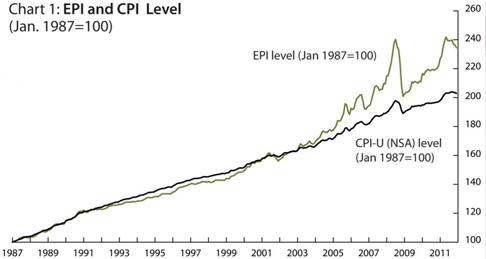
Think the CPI is weighted too heavily to big ticket items like cars, trips, building materials and technology? You aren't alone, and you're right in thinking that low-tech products have increased rapidly in price the last few years.
The American Institute for Economic Research agrees and took the idea to its logical conclusion. They only count items which the average American buys once a month or more. (Toothpaste in; computers out.)
"The index includes food and beverages, household energy products and services, other utilities, motor fuel, prescription drugs, child care fees, phone services, personal care products, and other goods and services purchased on a regular basis. "
Check out the AIER and the EPI.
Other Inflation Measures and Indices
There's no shortage of indices compiled to track inflation (Big Mac Index, anyone?). A number of new indices and indicators also are constantly released. We just wanted to shine a spotlight on a few of the more interesting ones for your next inflation argument!
Which inflation measures do you like the best? Can you pick a favorite? Do you think the CPI under or overstates true inflation? Do you like the Big Mac Index?
